Agentic media buying is redefining digital advertising in 2026. Digital advertising has always rewarded those who move fastest. But in 2026, speed alone is no longer enough. What separates high-performing brands from the rest is something more fundamental — the ability to build intelligent, self-optimizing systems that work continuously, not just during business hours.
Welcome to the era of agentic media buying. And for Indian marketers, the opportunity it presents is unlike anything we’ve seen before.
The Shift from Campaign Managers to AI Agents
Not long ago, running a successful digital campaign meant having skilled people watching dashboards, adjusting bids, pausing underperforming ads, and making judgment calls based on data. It was effective — but reactive, time-consuming, and limited by human bandwidth.
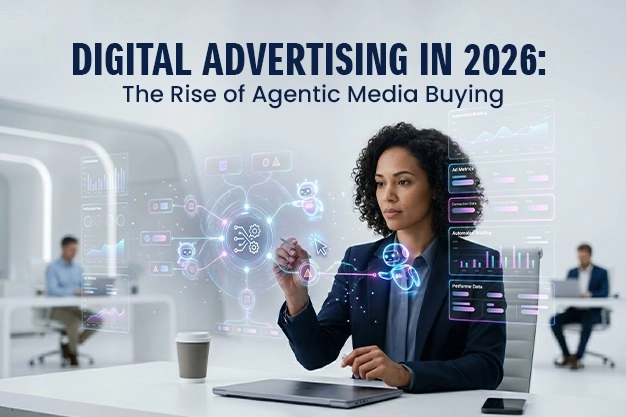
That model is being replaced. In 2026, forward-thinking agencies and brands are building what are best described as digital assembly lines — automated workflows powered by AI agents that monitor, optimize, and scale campaigns around the clock without waiting for a human to intervene.
These AI agents can track return on ad spend across Meta, Google, YouTube, and programmatic platforms simultaneously. They detect creative fatigue before performance visibly drops. They reallocate budgets in real time based on live performance signals. And they can trigger new creative production workflows automatically when existing assets stop delivering.
Consider the practical reality for an Indian e-commerce brand running a Diwali campaign across multiple platforms. Instead of a team scrambling to monitor performance manually, an AI agent identifies that a particular creative is losing traction in Tier 1 cities while gaining momentum in Tier 2 markets — and acts on that insight instantly. Budget shifts, underperforming assets pause, and new creative briefs are generated, all without a single manual input. This is not a future scenario. It is happening now. This is the power of agentic media buying.
Why India Is Uniquely Positioned to Benefit
India’s digital ecosystem is vast, fast-moving, and extraordinarily diverse. Consumer trends shift quickly, regional behaviors vary significantly across states, and seasonal spikes — from Diwali to IPL to end-of-season sales — demand responsiveness that human teams alone cannot consistently deliver.
Agentic systems are built precisely for this kind of complexity. They thrive on scale, diversity, and speed. For Indian brands trying to reach audiences across dozens of languages, cultures, and consumption contexts, an always-on optimization model is not just convenient — it is strategically essential. Campaigns become self-evolving rather than periodically reviewed, and the gap between insight and action closes from days to seconds.
Privacy Is the New Performance Infrastructure in Agentic Media Buying
While automation is reshaping how campaigns are managed, privacy regulation is reshaping how data is used. With third-party cookies now fully phased out, the tracking methods that once underpinned performance marketing no longer function as they did.
Two approaches have become the new standard. First, data clean rooms — secure environments where brands can analyze aggregated audience data without exposing individual identities, allowing advertisers to match their own first-party data with platform data in a privacy-compliant way. Second, server-side tracking through Conversions API, which replaces browser-based tracking by sending data directly from servers, making it far more reliable and far less vulnerable to browser restrictions.
For Indian D2C brands in particular, this shift demands investment in owned data infrastructure — stronger CRM systems, better customer data platforms, and clear compliance with evolving data protection norms. The brands that build these foundations now will hold a significant competitive advantage over those that delay.
The Marketer’s Role Has Been Elevated, Not Eliminated
There is a common anxiety that AI-driven automation diminishes the need for human marketers. The reality is the opposite. Agentic systems do not replace strategic thinking — they free marketers from reactive, repetitive execution so they can operate at a higher level.
In this new model, the best marketers are system architects. They design the workflows, set the creative direction, define the success metrics, and make the calls that require cultural intuition and brand judgment — the things AI cannot replicate. In a market as nuanced and opportunity-rich as India, that human layer is what turns a well-configured system into a genuinely effective one.
Building Smarter, Not Just Harder
The defining shift in digital advertising in 2026 is this: success no longer comes from working harder on individual campaigns. It comes from building smarter systems that continuously learn, adapt, and perform on your behalf.
For Indian brands willing to embrace this shift — investing in automation, strengthening first-party data, and keeping creativity at the center — the potential for scale is extraordinary.
The assembly line is built. The question is who’s going to run it best.
Ready to build a smarter digital advertising system for your brand?
Let’s start the conversation — https://voilawex.com/