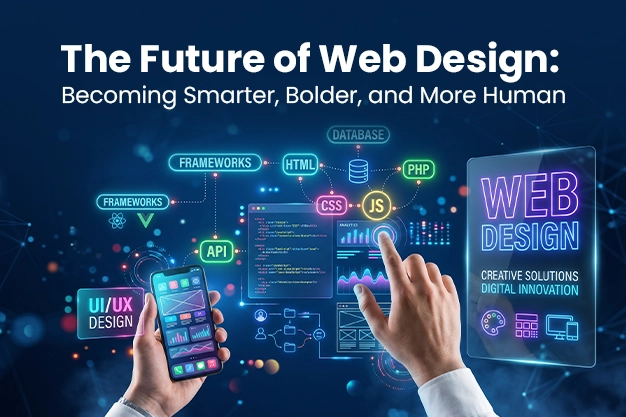
The future of web design is transforming faster than ever. The internet you knew five years ago is barely recognizable today. Web design — once the craft of building polished but passive digital pages — has evolved into something far more dynamic, intelligent, and human. In 2026, a website is no longer a digital brochure. It is a living, breathing experience that adapts, learns, and evolves alongside its users.
At VoilaWex India, we’ve always believed that great design sits at the intersection of technology and people. And right now, that intersection is more exciting than ever. Here’s what’s shaping the future of the web.
From Fixed Pages to Adaptive Interfaces
For a long time, every visitor who landed on a website saw the exact same thing — the same layout, the same content, the same journey. That era is over.
AI-powered adaptive interfaces are now reshaping how websites behave. Instead of static templates, modern websites can read user behavior, understand context and intent, and dynamically shift their presentation in real time. Think of a website that reorganizes its content based on what a visitor engages with, quietly fixes a broken element before anyone notices it, or continuously refines its own user experience without a developer touching a single line of code.
This isn’t just automation — it’s a fundamental shift in what a website can be. Platforms are now introducing concepts like “Agent Mode,” where AI systems can explore a codebase, detect issues proactively, and optimize interfaces based on live interactions. For businesses, this translates into higher engagement, lower bounce rates, and a user experience that only gets better over time.
The Rise of Agentic Web Experiences
We are moving from reactive web design to proactive web design. Traditionally, a website waited for a developer to push an update. Today, agentic systems are websites that anticipate user needs, learn from visitor patterns, and adapt their interface dynamically.
For users, this means faster navigation, more personalized journeys, and interactions that feel frictionless. The website stops being a tool you use and starts becoming a digital assistant that works with you. This shift has significant implications for how we approach web projects at VoilaWex India — designing for adaptability is now as important as designing for aesthetics.
The “Anti-Grid” Movement and the Return of Organic Design
Here’s something interesting: at the same time technology is getting more sophisticated, design aesthetics are swinging in a surprisingly human direction.
After years of rigid grid systems and predictable layouts, 2026 is embracing organic, fluid, and intentionally imperfect compositions. This movement — often linked to Neo-Brutalism — is defined by bold typography, high-contrast visuals, asymmetrical structures, and raw, unpolished aesthetics that feel alive rather than templated.
Why the shift? Because rigid grids, while consistent, bred repetition. Every website started looking like every other website. In a world increasingly flooded with AI-generated content, design that feels genuinely human has become a competitive advantage. Breaking symmetry, prioritizing emotional resonance, and allowing creative imperfection are now deliberate strategic choices — not design mistakes.
Micro-Interactions: From Decoration to Function
Animations and micro-interactions have always had a place in web design, but their role has matured significantly. Where they once served as decorative flair, they now perform a crucial function: making complex systems feel intuitive.
A subtle shimmer indicates that data is loading. A gentle motion guides a user to the next step in a process. A soft pulse lets a visitor know that AI is working in the background. These are not cosmetic choices — they are clarity tools. They reduce cognitive load, guide attention, and build trust, especially for neurodivergent users who benefit from clear visual cues and predictable feedback.
As AI becomes more deeply woven into web experiences, micro-interactions become the bridge between invisible intelligence and a user’s understanding of what is happening on screen.
The Bigger Picture: Human + AI, Together
What makes this moment in web design so compelling is the balance it strikes. Advanced AI capabilities are not replacing human-centered design thinking — they are amplifying it. The best web experiences of 2026 are simultaneously smart, expressive, and inclusive.
At VoilaWex India, this is the philosophy we bring to every project: intelligent design that puts people first. Whether you are launching a new product, rebuilding a digital presence, or rethinking how your brand connects with users online, the future of web design is full of possibility.
The web is becoming alive again — and we are here to help you be part of it.
Looking to transform your digital presence? Connect with VoilaWex India at www.voilawex.com.