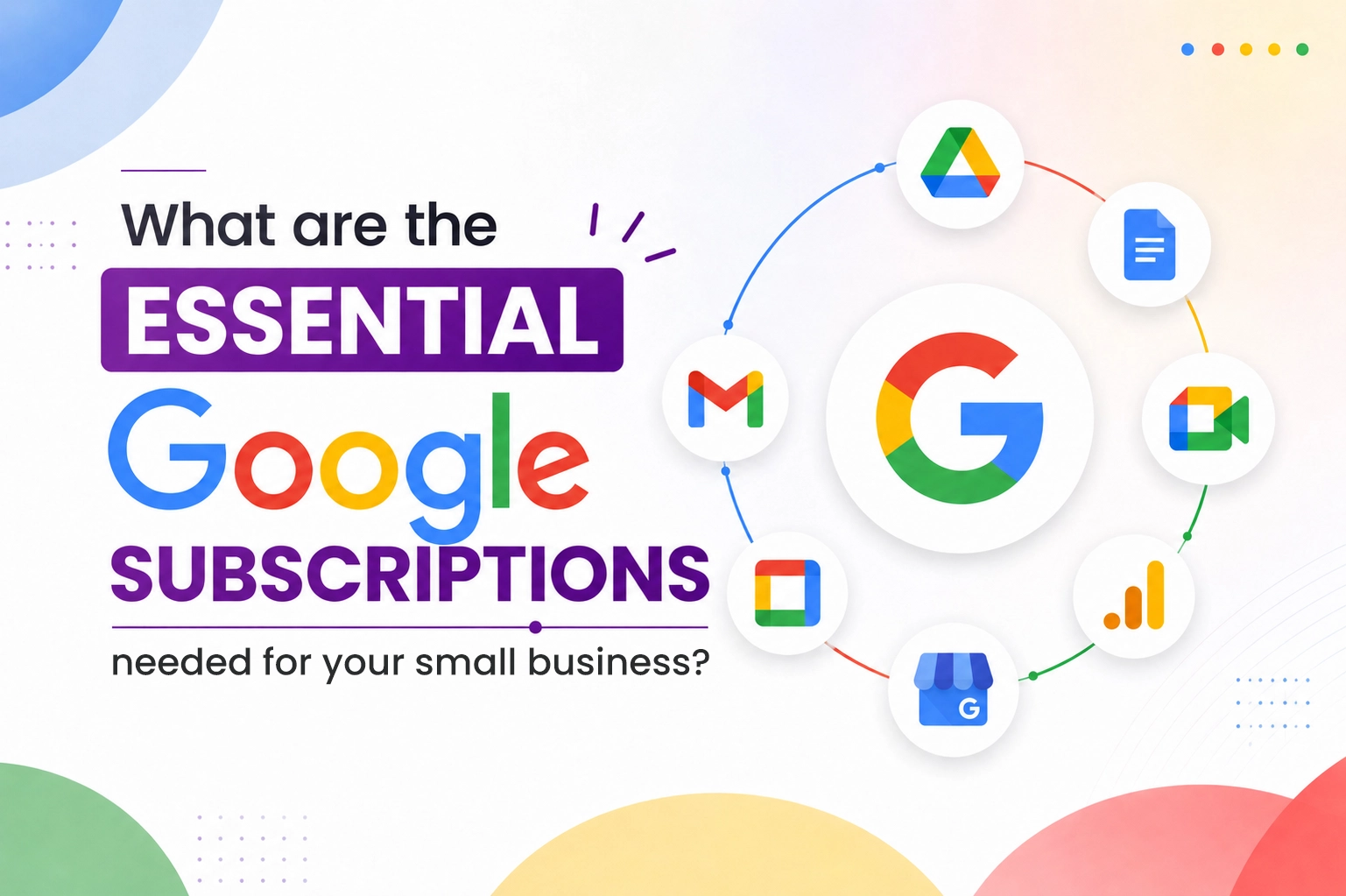
If you’re running a small business and searching “best Google subscription for small business,” you’ll quickly notice something: Google doesn’t sell one all-in-one marketing package. Instead, it offers a mix of paid subscriptions, pay-as-you-go ad spend, and genuinely free tools — and figuring out which combination makes sense for a limited budget can feel more confusing than it should.
At VoilaWex India, we get asked this almost every week by small business clients, so here’s a straightforward breakdown of what’s actually worth paying for, and what you can start using for free.
The One Paid Subscription Most Businesses Need First: Google Workspace
If there’s a single Google subscription that qualifies as essential infrastructure rather than a marketing tool, it’s Google Workspace.
It bundles professional business email (using your own domain instead of a generic Gmail address), Google Drive for file storage, Docs and Sheets for collaborative work, Calendar for scheduling, and Meet for video calls — all in one connected environment your whole team can use together.
As of 2026, Workspace pricing sits at roughly $7/user/month for Business Starter and $14/user/month for Business Standard on annual billing, with Gemini AI features now built directly into the plan rather than sold as a separate add-on the way they used to be.
That’s a meaningful shift: Business Standard and above now include AI assistance inside Gmail, Docs, Sheets, and Meet at no extra cost, which means a small team can get both professional collaboration tools and AI-assisted drafting, summarizing, and content creation from a single subscription.
If your team is still using a mix of personal Gmail accounts and scattered file-sharing links, this is usually the first upgrade worth making.
Google Business Profile: Free, and Non-Negotiable for Local Visibility
This one isn’t a subscription at all — it’s free — but it belongs on this list because skipping it is one of the most common mistakes small businesses make.
Google Business Profile controls how your business shows up in local search results and on Google Maps: your hours, address, phone number, reviews, and photos.
For any business that serves local customers, claiming and actively maintaining this profile does more for visibility than almost anything else you could pay for.
There’s no reason not to have one set up correctly from day one.
Google Ads: Pay-Per-Spend, Not a Flat Subscription
Once you’re ready to actively pursue leads or sales rather than relying purely on organic visibility, Google Ads becomes relevant.
It’s worth understanding that this isn’t a subscription in the traditional sense — you’re not paying a flat monthly fee for access. Instead, you set a budget and pay based on actual ad spend across Search, Maps, and YouTube.
This makes it flexible for small businesses, since you can start with a modest daily budget and scale up only once you’re confident the campaigns are generating a return.
The key is not jumping into Ads before you have a functioning website and a way to track what happens after someone clicks — otherwise you’re paying for traffic you can’t measure.
Google Analytics: Free, and Essential for Measuring Everything Else
Google Analytics rounds out the essentials, and like Business Profile, it’s free for standard use.
Once you’re running any kind of marketing — organic content, paid ads, email campaigns — Analytics is how you find out whether any of it is actually working.
It tracks website traffic, user behavior, and campaign performance, giving you the data to double down on what’s working and cut what isn’t.
Skipping this step means running marketing efforts somewhat blind.
A Practical Order of Operations
For a small business working with a limited budget, we generally recommend this sequence:
- Start with Google Workspace for professional email and team collaboration — it’s the operational backbone.
- Set up Google Business Profile immediately for local visibility — it costs nothing and pays off quickly.
- Add Google Ads only once you’re ready to spend on lead generation or sales — don’t rush into paid traffic before your foundation is solid.
- Use Google Analytics from day one to measure results across everything else you do.
The Bottom Line
The most practical Google stack for a small business isn’t an expensive bundle — it’s one core paid subscription (Workspace) supported by tools that are either free (Business Profile, Analytics) or billed purely on usage (Ads).
You don’t need to subscribe to everything at once, and you shouldn’t.
Build the foundation first, measure as you go, and add paid traffic only when you’re ready to make the most of it.
At VoilaWex India, we help small businesses figure out exactly this kind of stack — matching the right tools to your budget and goals instead of over-subscribing to things you don’t need yet.